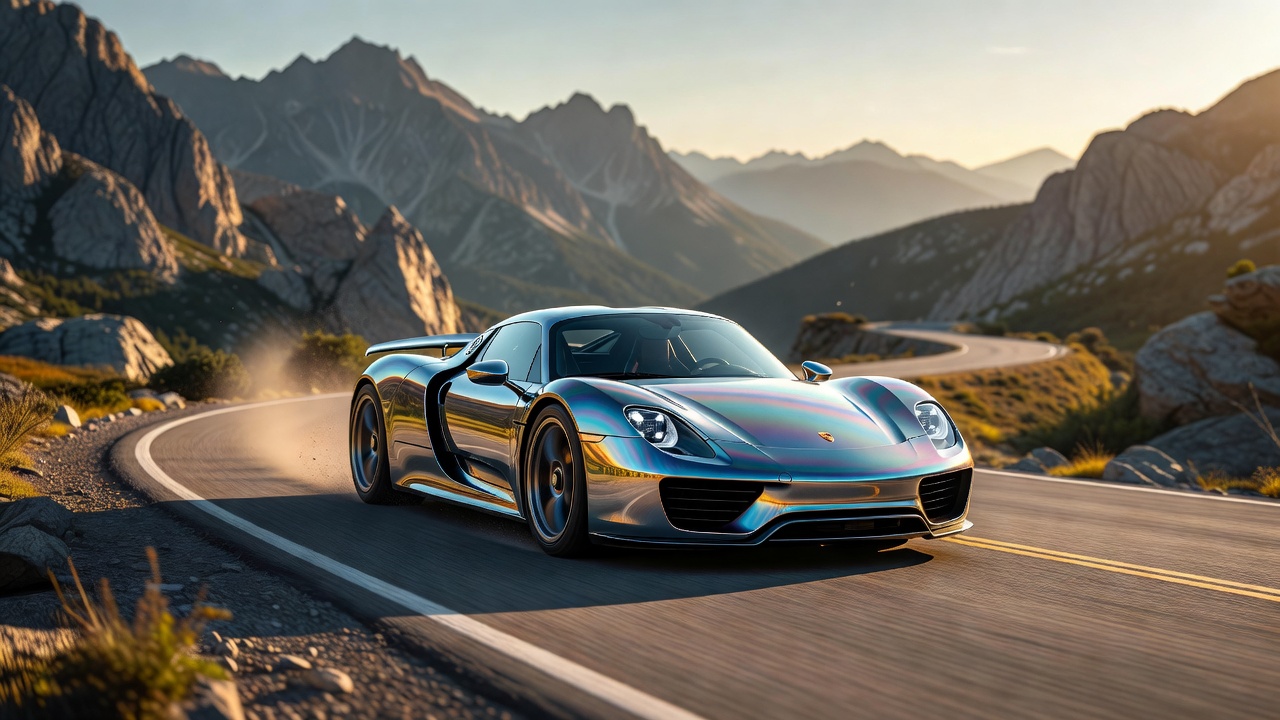
Over a decade after its initial unveiling, the Porsche 918 Spyder retains a mythical status in the automotive hierarchy. As one third of the fabled "Holy Trinity" (alongside the McLaren P1 and Ferrari LaFerrari), the 918 was arguably the most technologically ambitious of the three, utilizing a complex all-wheel-drive plug-in hybrid system that served as a blueprint for the modern performance landscape.
A Motorsport-Derived V8 Heart
While the hybrid system garnered the headlines, the core of the 918 Spyder is a masterpiece of internal combustion. The 4.6-liter naturally aspirated V8 is heavily derived from the engine used in the RS Spyder LMP2 race car. Weighing merely 298 lbs, it sits low in the carbon-fiber tub and features a flat-plane crankshaft, allowing it to rev to a screaming 9,150 rpm.
Unique to its design are the "top pipes"—an exhaust system that exits directly upwards through the engine cover. This radical routing ensures that extreme exhaust heat is vented quickly away from the lithium-ion battery pack mounted lower in the chassis, reducing cooling demands and keeping vehicle weight optimized.
Dual-Motor Hybrid Architecture
The 918 pairs its V8 with two electric motors. A 156-horsepower motor sits on the rear axle, integrated in parallel with the 7-speed PDK transmission, allowing it to drive the rear wheels independently or in tandem with the engine. A secondary 129-horsepower motor sits on the front axle, providing the 918 with highly responsive all-wheel drive.
At low speeds, the front motor handles all propulsion, enabling silent, emissions-free driving. When maximum attack is required, both motors deliver instantaneous torque that effectively masks any gap in the naturally aspirated V8’s power band. A mechanical clutch decouples the front motor at speeds above 165 mph to prevent it from over-spinning.
The Weissach Package
For buyers focused on absolute lap times, Porsche offered the Weissach Package. This lightweight track-oriented option stripped away creature comforts, removed sound deadening, and utilized magnesium wheels, ceramic wheel bearings, and titanium chassis bolts. The package shed approximately 90 lbs from the standard car, enhancing aerodynamic efficiency with additional carbon-fiber aero-flics on the rear and an extended rear diffuser.
It was a 918 Spyder equipped with the Weissach Package that famously broke the 7-minute barrier at the Nürburgring Nordschleife, laying down a blistering 6:57 lap time that cemented its place in history.
Legacy and Sustained Relevance
What makes the Porsche 918 Spyder extraordinary is how profoundly it predicted the future. The seamless integration of front-axle electric motors for torque vectoring, the reliance on plug-in hybrid capacity to appease urban emissions regulations, and the philosophy of using electric torque as a performance enhancer rather than just a fuel-saving measure are all concepts that the broader industry has only recently adopted.
The 918 Spyder is not merely a fast car; it is a meticulously engineered crystal ball that accurately showcased the trajectory of high-performance automotive engineering for the next twenty years.