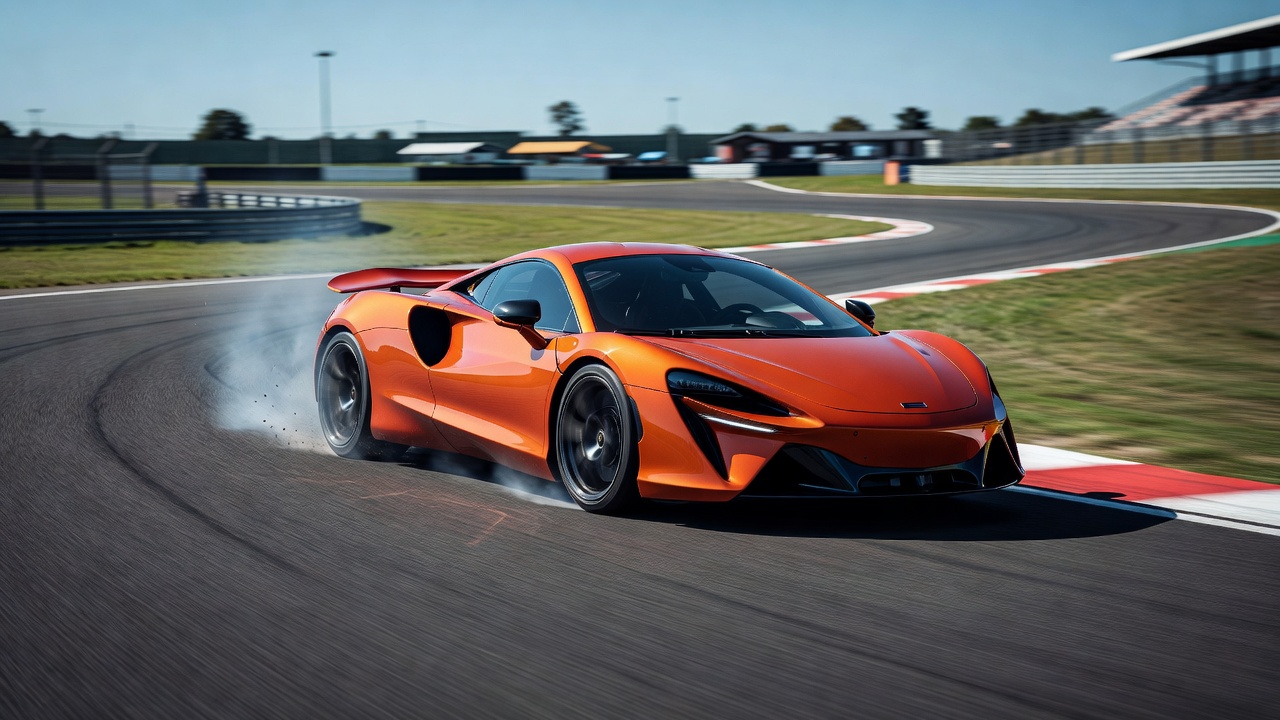
The McLaren Artura represents a foundational shift for the British marque. Moving away from the ubiquitous V8 architecture that defined every modern McLaren since the MP4-12C, the Artura introduces an entirely new powertrain, a bespoke chassis, and an electrical architecture designed from the ground up to integrate hybrid propulsion without compromising the brand’s obsessive focus on lightweight driver engagement.
The M630 V6 Engine
At the heart of the Artura sits the M630, an all-new 3.0-liter twin-turbocharged V6. Unlike traditional V6 engines, the M630 utilizes a 120-degree bank angle. This wide "hot vee" configuration serves multiple engineering purposes. First, it allows the turbochargers to sit within the valley of the engine, drastically reducing the length of the exhaust plumbing. This minimizes turbo lag and improves thermal efficiency.
Second, the 120-degree angle lowers the engine's center of gravity compared to a narrower V or a traditional V8. The engine block itself is constructed using 3D-printed cores to achieve cooling passages that would be impossible to cast conventionally. The result is a combustion engine that produces 577 horsepower while weighing roughly 110 lbs less than the outgoing V8.
Axial Flux Electrification
Instead of a standard radial flux electric motor, McLaren opted for an axial flux E-motor situated within the transmission bell housing. Axial flux motors are denser, lighter, and more compact. Generating 94 horsepower and 166 lb-ft of torque, this motor’s primary role is "torque infill"—providing instantaneous acceleration while the turbochargers spool.
Because the electric motor is so efficient, McLaren did away with a mechanical reverse gear entirely. When the driver engages reverse, the electric motor simply spins backward, saving crucial weight and mechanical complexity in the new 8-speed dual-clutch transmission.
The MCLA Chassis
Weight is the enemy of performance, and batteries are inherently heavy. To offset the 287-lb penalty of the 7.4 kWh battery pack and electric motor, McLaren developed the McLaren Carbon Lightweight Architecture (MCLA). Manufactured in Sheffield, this new monocoque integrates the battery compartment directly into the carbon structure, increasing torsional rigidity and ensuring the battery is protected during a crash without requiring heavy external shielding.
Driving Dynamics & Verdict
On the road, the integration of these systems is remarkably seamless. The transition from EV mode to internal combustion is handled via an advanced clutch mechanism that starts the V6 without jarring the cabin. The hydraulic steering—a McLaren hallmark—remains untouched by the electrical systems, offering the same telepathic feedback drivers expect from Woking.
The Artura proves that hybridization in the supercar segment does not have to mean a bloated curb weight. By adopting a ground-up approach to the chassis and utilizing advanced axial flux motor technology, McLaren has created a hybrid supercar that feels analog in its responses yet thoroughly digital in its capabilities.